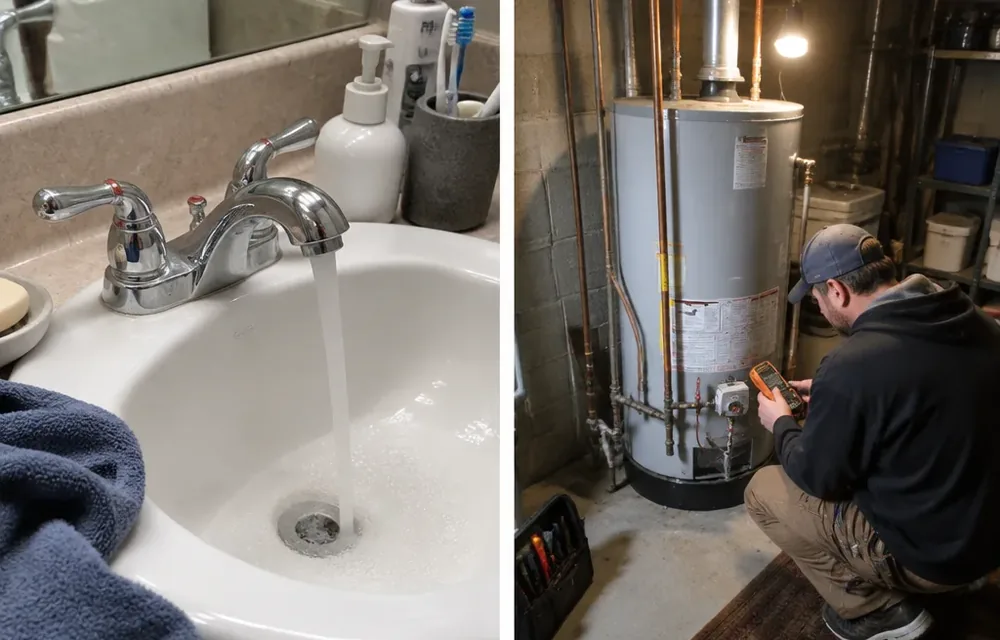
Signs
Cold taps with no warm-up
Every hot tap running cold after normal use often means a tripped reset, a failed element or thermostat, or a burner or ignition fault rather than a fixture issue.
Short showers that fade halfway
Water that starts warm and turns cool mid-shower often traces to sediment cover, a tired lower element, or a tank sized below current use.
Relief discharge or tank moisture
Water at the relief line, drain valve, or tank seam joined with loss of heat means safety devices or the vessel need attention before reset attempts.
Boiler-fed loss with cold radiators
Homes with indirect tanks that lose hot water while rooms also cool often have a boiler or zone control fault feeding the tank.
No hot water is a heat-source fault, not a fixture fault
Short answer: no hot water is a failure to heat or deliver stored heat, while single-tap trouble is usually a valve or cartridge. No hot water affects every hot tap or a whole bath group at once, and the heater shows a tripped device, an error code, or water where it should be dry. When only one shower runs cold while nearby hot taps run warm, the mixing path at that fixture deserves the first look.
What you are seeing: electric tanks often lose an element or thermostat, gas units often lose ignition or gas control behavior, and indirect tanks lose the boiler zone that feeds them. Sediment blankets the bottom and forces longer burns for less usable heat, so showers shorten over time before failing outright. A relief valve that has discharged leaves mineral trails and a damp tube that should not be ignored.
Why order matters: resetting without checking for moisture, blocked venting, or repeated trips can mask the cause and invite another loss. Note whether the loss was sudden after a storm or outage, gradual over weeks, or tied to overlapping laundry and showers. That pattern tells us whether controls, buildup, sizing, or the boiler side should be tested first.
Controls, buildup, and fuel-side faults cause most loss
Short answer: tripped safeties, worn parts, sediment, and fuel or power interruptions cause most no-heat calls. A tripped electric reset, a scaled lower element, a thermostat that no longer senses, and a gas control that will not hold flame each cut heat while the tank itself remains sound. Each leaves a distinct clue at the breaker, the status light, or the shower pattern.
Tank-side causes: hardness minerals settle into an insulating blanket that rumbles during heating and starves the upper volume, and anode wear lets the lining pit until pinholes weep. Loose or weeping top fittings, a tired relief valve, and a partially closed cold feed all reduce delivery without any error code. Tight basement corners that trap damp air hide small seeps behind storage until the base shows rust.
House-side causes: a tripped breaker after an outage, a heater switch left off after service, a tempering or mixing valve set too low, and overlapping high use can all mimic a dead heater. Boiler-fed homes add circulator, zone valve, and low-water behavior that starve an indirect tank while radiators also lag. Cold snaps expose weak combustion air and long lateral vents that spill or lock out under wind.
Some cold showers are not heater failures
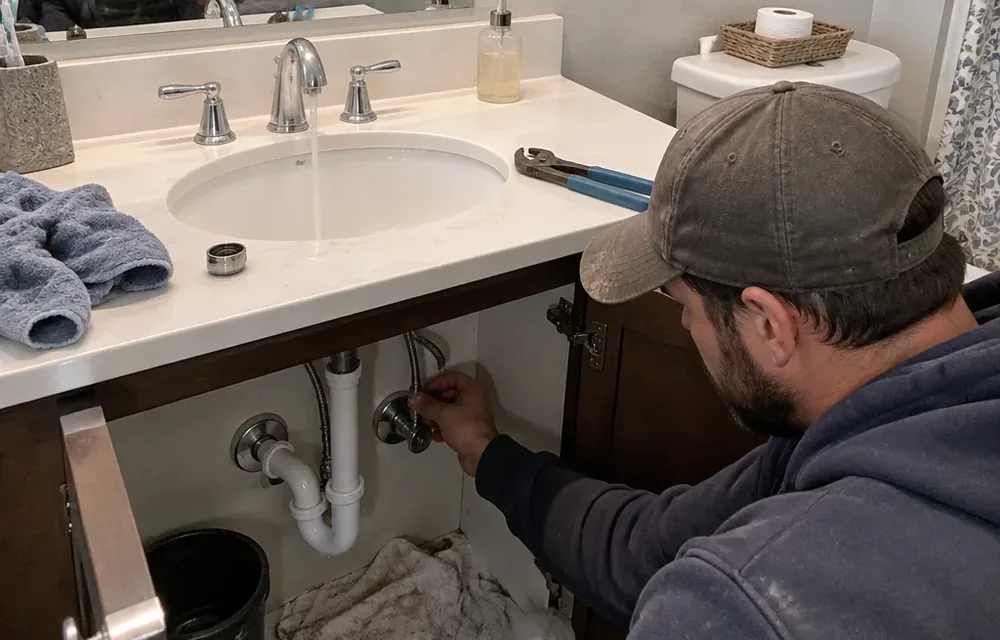
Short answer: a worn shower cartridge, a tempering valve turned down, or a cross-connection can mimic a dead heater. When nearby hot taps run warm while one shower runs cold, the mixing valve or cartridge at that bath is more likely than the tank. A recirculation loop passing through a running toilet or a faulty check can also temper the whole hot branch.
Valve and fixture look-alikes: single-handle cartridges that no longer blend, tub spouts that leak cold into the hot path, and point-of-use tempering devices set low each cap temperature at one point. A dripping faucet on the hot side that never fully closes can bleed heat continuously. Testing several hot taps in sequence separates point trouble from tank trouble.
Supply and pressure look-alikes: a clogged aerator or a partially closed stop makes hot flow feel weak and cool at one tap while the tank tests sound. Whole-house low water pressure from a control or treatment unit can starve the heater feed and shorten delivery. When rust clears after a few seconds at one tap only, the branch or fixture may be the source rather than the vessel.
Loss follows familiar Chelmsford-area setups
Short answer: basement tanks, hard water, and boiler-fed zones shape local no-heat calls. Heaters tucked into tight basement corners around Chelmsford, colonials with oil-indirect tanks near Billerica and Concord and electric tanks on mineral-bearing town water all show distinct wear.
Where tanks work hard: town water carries hardness that settles as sediment and forces longer, hotter burns, which pops, rumbles, and stresses the lining. Cool, damp basements keep relief drips and small seeps hidden behind storage, and laundry plus bath overlap during morning hours drains marginal tanks before the day begins. Long vent laterals in older basements corrode quietly and spill under wind.
Where controls lag: additions that added baths without resizing the heater stretch first-hour delivery, and finished walls that box the heater tight limit service clearance and combustion air. Streets with steady street pressure show weak expansion behavior first at relief lines and toilet fills. Homes with softeners overdue for service send resin fines and scale downstream that foul mixing paths and shorten usable heat.
A heater visit tests before parts and explains repair or swap
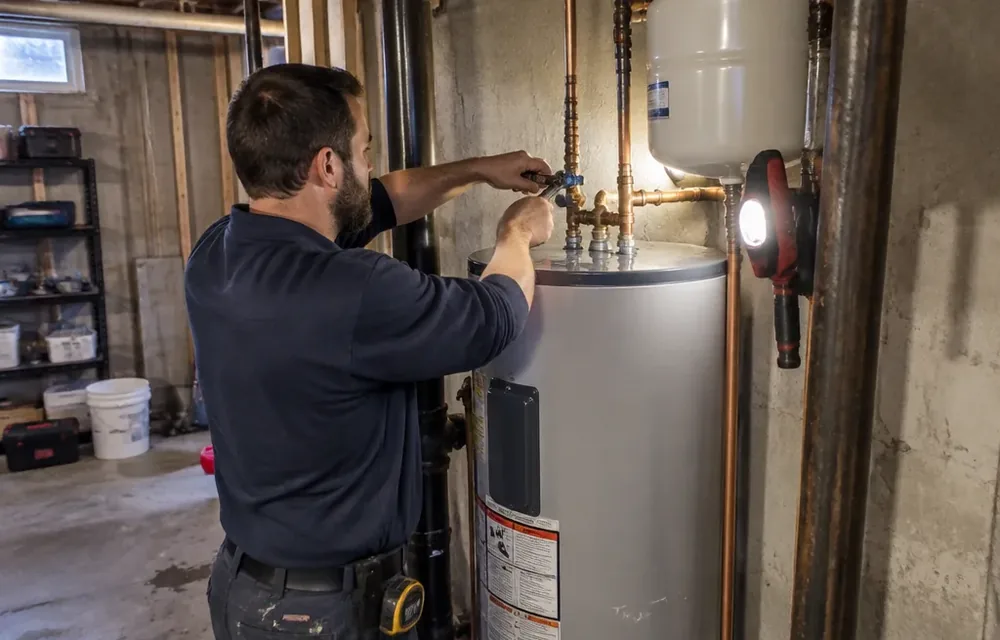
Short answer: a water heater installation and repair visit checks power and fuel, tests controls in sequence, and inspects tank and vent before recommending a path. We record loss pattern, noises, and any water at the base, then verify breaker, switch, reset, and status codes. You see readings before any part is changed.
How testing proceeds: thermostats, elements, burner behavior, ignition, relief discharge, and expansion behavior are checked in an order that rules out simple parts before vessel faults. The seam, base, top fittings, and flue are inspected with a light, and hot taps are run in sequence to confirm delivery under use. Where a boiler feeds the tank, zone behavior and boiler controls join the same test.
How the choice is framed: sound steel with one failed control or fitting often returns with a part and a flush, while seam weeps, a rusted base, repeated relief lift after checks, or a flue that cannot be made sound point toward a new unit. Fuel, vent path, condensate handling, and household shower overlap shape sizing more than the old label. We lay out repair and swap trade-offs in plain terms so the decision rests on test results.
Safe homeowner checks help while force harms
Short answer: note codes, check power, and contain moisture without opening panels or resetting repeatedly. Look at the breaker and heater switch, write down any status light pattern, and feel for moisture at the base and relief tube without removing covers. Space showers and laundry so the tank can recover while you track the pattern.
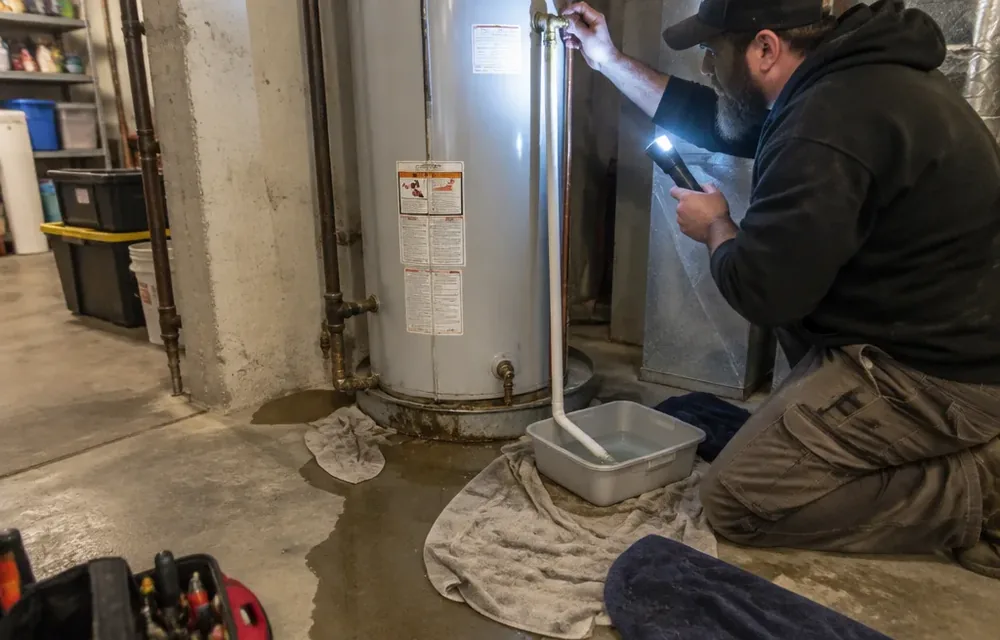
What you can do safely: close the cold feed if water pools at the base, place towels and a shallow pan to protect the floor, and keep storage clear of the burner door and vent hood. Photograph the rating plate, the status display, and any damp area for the visit. Keep the room ventilated and keep clear of gas odor or scorch marks, which need utility clearance before heater work.
Harm and comfort risk from delay or force: repeated resets on a faulting control can overheat wiring and mask a failing part, and water left pooling at the base rusts the jacket and wicks into nearby storage and framing. A relief line that keeps discharging signals pressure or temperature behavior that should not be capped or plugged. Opening gas or electric compartments without training risks shock and combustion trouble, so observation and moisture control protect more than repeated switching while help is on the way.
The service that fixes it
Related services
Related problems
Frequently asked questions
Why did hot water stop overnight?
Overnight loss often traces to a tripped reset or breaker, a failed element or thermostat, or an ignition fault that locked out during the night. Note any error code, check the heater switch position, and look for moisture at the base. We test controls in sequence so a simple part is not mistaken for a failed vessel. Pattern and fuel type guide the first checks.
Why do showers turn cool halfway through?
Short delivery often means sediment cover, a tired lower element, or use that exceeds first-hour capacity during overlapping showers and laundry. Feel whether all hot taps fade together or only one bath fades, because whole-tank fade points to heat and storage while single-bath fade points to mixing. Flushing helps early buildup but rarely reverses deep scale alone.
Should I reset the water heater myself?
You can note the reset and status display once and check the breaker without removing covers. Avoid repeated resets when tripping recurs, and avoid opening electric or gas compartments. If moisture, relief discharge, gas odor, or scorch marks are present, leave controls alone and call us. One careful observation helps more than repeated switching.
When does an indirect tank point to boiler trouble?
When radiators also lag, zones call without heat, or the boiler shows a lockout while hot water fades, the boiler side is likely starving the tank. Note gauge behavior, which zones stay cold, and any recent air bleeding. A heater-only fix will not hold until circulators, zone valves, and controls are tested. See boiler with no heat for the shared checks.
Seeing no hot water?
Call and describe the symptom. A local specialist will tell you the sensible next step.