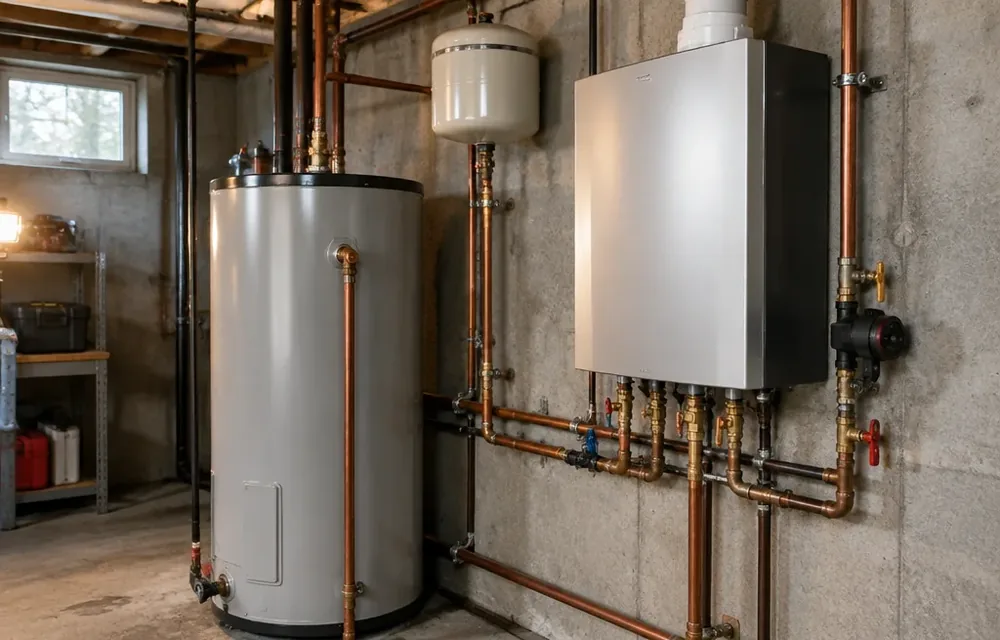
How do tank and tankless heaters work?
Heater mechanism: Tank heaters hold a stored volume and reheat it as thermostats call, while tankless units fire only as hot taps open and heat water passing through the exchanger. Heater mechanism differs in standby, since tanks maintain stored heat and tankless units rest cold between uses.
What that means daily: Stored supply gives a ready draw until the tank mixes down, then recovery lags while the burner or elements reheat. On demand supply gives continuous flow within its heating capacity, then thins when too many hot taps overlap. Note shower overlap, tub fills and laundry timing, because that use map matters more than the old label. See no hot water clues for failure patterns and heater leak checks for vessel signs.
Fuel and vent paths: Gas tanks vent through a flue with combustion air needs, electric tanks wire to dedicated circuits, and tankless gas units need sized gas lines plus sealed venting and condensate handling. Each path changes room work beyond the box itself. That is why a site look at gas size, vent run and drain access through gas piping review precedes any switch.
Which heater fits your home, and how can you tell?
Fit factors: Fit factors for heaters include household shower overlap, space and vent path, fuel available, and mineral load in the supply. Fit factors that favor tanks include closets built around a tank footprint and families with clustered morning showers.
Tank lean signs: A home leans tank when the existing flue and gas line suit a direct swap, when floor space already holds a tank with pan and drain, and when use clusters into back to back showers that stored supply covers. Mineral heavy supply also leans tank where flushing and anode care fit routine upkeep. Review hard water notes while weighing this path.
Tankless lean signs: A home leans tankless when wall space frees floor area, when hot use spreads through the day rather than stacking, and when venting can route sealed pipe to outside with condensate handled. Homes that cook and wash across the day rather than in one rush feel the on demand benefit most. Confirm gas sizing and treatment needs through water heater service before assuming the switch is simple.
What to do in order before choosing
Ordered choice: An ordered heater choice starts with use logging, then space and vent review, then condition testing of the current unit. An ordered heater choice avoids picking hardware before the home proves what it can host.
Log use and space: Count back to back showers, tub fills and overlapping laundry and dishwashing across a typical morning. Measure the closet or basement corner, note flue path and nearby drain for pan or condensate, and record fuel type and panel space. Share heater age from the rating plate, noises and rusty first draw notes. If water pools at the base or sprays from top fittings, close the cold feed and call (978) 592-1168 rather than waiting on a comparison. See emergency help for active leaks.
Test before replacing: Ask for control testing, tank seam and base inspection and draft review on gas units before condemning the vessel. A mid life tank with one failed element or thermostat often returns with a part and a flush. Only when the vessel or venting reaches its limit does the tank versus tankless table below guide the swap through the cost guide context.
Tank versus tankless compared
Comparison frame: Tank versus tankless differs in storage, space, venting and care, not in one being right for every home. Tank versus tankless choice rests on shower overlap, room layout and mineral load more than on habit or trend.
Read the rows: Use the table below to match your home to the sounder fit. Clustered showers with a ready flue lean tank, while spread use with a clear sealed vent path leans tankless where gas and treatment allow. Hard supply without treatment punishes tankless exchangers and scales tanks alike, so treatment planning belongs in either column. Pair the table with water heater service details and treatment notes.
No hard efficiency or age promises: Both types vary with sizing, use and upkeep, so compare mechanism and fit rather than fixed savings or fixed service spans. A well sized tank with sound venting often outlasts a poorly fed tankless starved of gas or choked by scale. Let the site review of gas line, vent run, water quality and drain access decide more than brochure language.
| Feature | Tank heater | Tankless unit |
|---|---|---|
| How it supplies | Draws from stored hot volume then reheats | Heats water on demand as taps open |
| Best use fit | Clustered back to back showers and tub fills | Spread out use with fewer overlapping hot taps |
| Space and placement | Floor footprint with pan and drain path | Wall hung freed floor with clear vent route |
| Venting and fuel | Uses existing flue or circuit with least change | Needs sized gas line plus sealed vent and condensate |
| Water quality care | Needs flushing and anode attention on mineral supply | Needs scale control and service valves on mineral supply |
| When it struggles | Runs short when stored supply mixes down | Thins when too many hot taps overlap capacity |
Why Chelmsford area homes choose each path
Local pattern: Chelmsford area homes choose tanks where basements already host a tank beside the boiler with a short vertical flue. Chelmsford area colonials with tight utility corners also favor direct swaps that avoid reworking finished walls.
Where tankless appears: Wall hung units appear in additions and remodels where floor space matters and a sealed vent can route cleanly outside. Homes on mineral steady town supply through the Lowell Regional Water Utility system pair either choice with treatment planning, since scale punishes both vessels in different ways. Similar splits show near Tewksbury splits with tight corners, near Acton colonials with long vent runs, and near Bedford ranches with open basements.
What to share on the call: Describe shower overlap, tub size, fuel type, flue path and available wall versus floor space. Mention spotting, rumbling and rusty draw that mark mineral load. Those facts let the visit size stored volume or on demand capacity from routine rather than from the old sticker through water treatment review.
Limits of both heater types
Heater limits: Heater limits appear when the fault sits outside the vessel, such as a worn shower mixing valve, a tempering valve set low, or a boiler control feeding an indirect tank. Heater limits also appear when single tap pressure loss traces to aerators and stops rather than supply temperature.
Tank specific limits: Tanks cannot stretch stored supply beyond their volume, so clustered demand still needs scheduling or a larger rating. They also cannot survive a weeping seam or rusted base with parts alone. Tankless units cannot cover wide overlap beyond capacity and cannot tolerate neglected scale control on mineral supply. Review low pressure signs and running toilet waste that can mimic short hot supply before condemning either type.
Space and vent boundaries: Tight closets without combustion air, long lateral flues in poor shape and missing condensate paths can rule out an otherwise attractive option. Electrical capacity and gas line size set further boundaries that no control setting overcomes. A site measure of those paths through gas piping review keeps the plan honest.
When to call for water heater help in Chelmsford
Call timing: Call timing for heater help fits no hot water, short showers that persist after basic checks, water at the tank base, relief discharge and rumbling with rusty draw. Call timing also fits any gas odor or flue damage, where safety leads the visit.
How to call well: Call (978) 592-1168 with symptom pattern, fuel type, rating plate age and photos of valves and venting ready. Close the cold feed and power or gas path only where valves move freely and access stays dry, and leave relief and vent work alone. Ask whether testing points to repair or to the tank versus tankless choice above. See emergency plumber notes and what moves the price for scope.
Massachusetts rules: Water heater work in Massachusetts follows 248 CMR, the Uniform State Plumbing Code, with fuel gas rules for gas units and oversight by the Board of State Examiners of Plumbers and Gas Fitters as listed on mass.gov. We set safe delivery temperature, verify draft on gas units, confirm relief discharge paths and leave shutoff locations marked. Permits move through the local inspector before swaps.
Near you
When to call
Related guides

Frequently asked questions
Should I pick tank or tankless for back to back showers?
A tank often suits back to back showers because stored supply covers clustered draws before recovery lags. Tankless can thin when many hot taps overlap beyond capacity. Log morning shower count, tub fills and laundry overlap, then match that routine to the table above. Space, vent path and mineral load refine the final fit.
Does hard Chelmsford water change the choice?
Hard supply affects both types, scaling tank bottoms and coating tankless exchangers without treatment. Tanks lean on flushing and anode care, while tankless units lean on scale control and service valves. Tested mineral levels plus heater noise history guide treatment sizing. Plan treatment with either vessel rather than after it scales.
Can I switch from electric tank to gas tankless easily?
A fuel switch is rarely simple because gas sizing, sealed venting, condensate handling and combustion air all change the room. Panel capacity freed on the electric side does not offset gas path work. A site review of gas line, vent route and drain access decides feasibility. Start with a heater service visit before choosing hardware.
Repair or replace my current tank?
Repair fits a mid life tank with sound steel and one failed control or fitting. Replacement fits seam weeps, rusted bases, repeated relief lift after checks and flues that cannot be made safe. Control testing plus vessel and vent inspection decides more than age alone. Bring symptom notes and rating plate details to the visit.
Still stuck?
Describe what you see when you call and a local specialist will guide the next step.