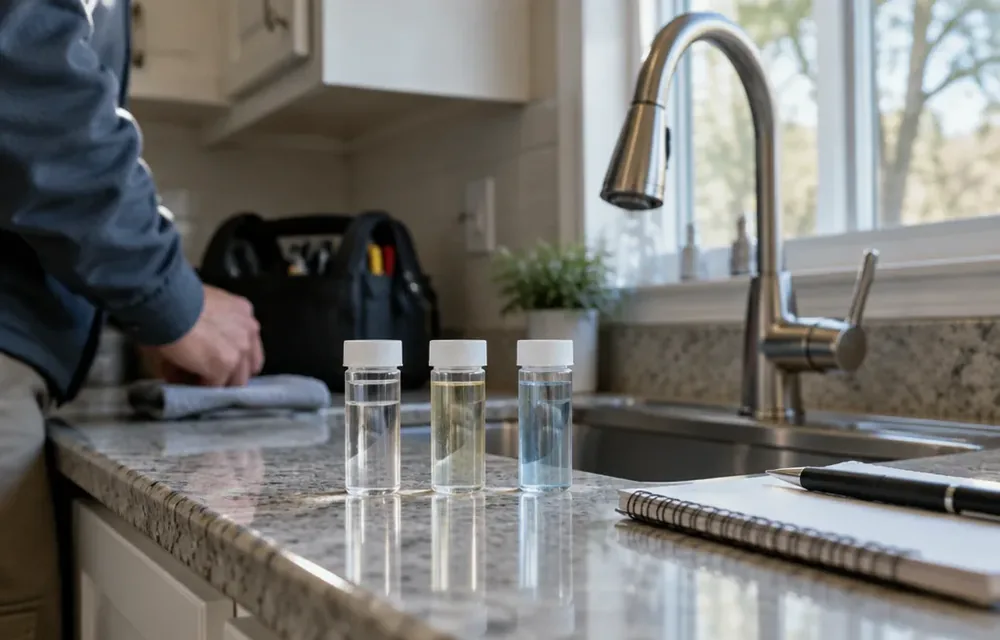
What the 2025 reports show
Headline finding: Most town supplies in this area are soft to moderately hard, so the region does not have a general hard-water problem. MWRA water feeding Bedford, Lexington, Reading and Stoneham tested 14.4 milligrams per liter of hardness at the Carroll plant in May 2026, about one grain per gallon. Surface-water systems test soft as well: Tewksbury reports one to two grains, Methuen 15 to 30, North Andover 35.1, Andover and North Reading 37, and Pennichuck supply 20.8. Well-fed systems are where hardness climbs, with Westford at 83.5 in its May 2025 sample, Concord averaging 85 across a 58 to 117 range, South Acton near 81, and Sudbury ranging 55 to 194 across its wells.
Sodium is the bigger local finding: Billerica reported sodium up to 124 parts per million in 2025 with chloride at 185, North Chelmsford Water District averaged 94.4 with chloride at 260 against a 250 secondary standard, and Chelmsford Water District averaged 88.65. Woburn Horn Pond wells ran 96 to 100, Wilmington averaged 70.5, Westford 69 and Acton wells 56 to 67, while Lincoln, Pepperell and Lawrence stayed near or below 27. None of those is a health violation, since sodium has no enforceable limit, but they matter for anyone on a low-sodium diet and they add to corrosion risk on older plumbing.
How to use your row: Find your town, confirm the supplier against your water bill, and read the source link on that row. Blended towns such as Burlington, Wilmington and Woburn draw partly from MWRA and partly from local wells, so your tap can sit anywhere between the two profiles depending on the day and your street. Chelmsford has three separate districts with different sources, so match your street to its district first. Private-well streets skip every supplier row and start with certified lab testing instead.
Hardness, iron, manganese, and pH in plain terms
Hardness: Hardness measures dissolved calcium and magnesium that drop out as scale when water heats or dries. On the USGS scale, 0 to 60 milligrams per liter is soft, 61 to 120 moderately hard, 121 to 180 hard and above 180 very hard. One grain per gallon equals about 17.1 milligrams per liter, which is how dishwasher and softener settings are usually entered. Most town rows in this table fall in the soft or moderate bands; only individual Sudbury wells and the top of the Concord range reach toward the hard band.
Iron and manganese: Iron stains orange and clogs aerators, while manganese darkens fixtures and laundry at far lower concentrations. Both come from groundwater geology rather than treatment failure, which is why well-fed systems such as Westford, Littleton and Wilmington filter them out at the plant. Aesthetic limits are 0.3 milligrams per liter for iron and 50 micrograms per liter for manganese. Town-supply staining in a filtered system usually points to old premise plumbing or disturbed sediment after hydrant flushing rather than source chemistry.
pH and sodium notes: Suppliers raise pH on purpose to protect lead and copper plumbing, so higher numbers here are a design choice rather than a defect. MWRA targets 9.3 in its distribution system and tested 9.7 leaving the Carroll plant in May 2026, while Burlington Mill Pond water ran 9.11 and Woburn Horn Pond 8.3. Sodium comes from several routes at once: road salt reaching wells and rivers, natural deposits, and treatment chemicals, since Tewksbury, Methuen and MWRA all adjust pH with sodium compounds. Neither pH nor sodium argues for or against a softener on its own, and ion-exchange softeners add sodium rather than removing it.
The supplier table
Reading guide: Each row names the supplier, the published values, and a link to the document behind them. Values carry their sample date or report year where the source gives one; town FAQ figures are long-standing supplier statements rather than single samples. Rows marked not found mean we could not locate a published figure in September 2026, not that the water is untested, and the linked page is where that supplier posts its annual report.
Standout rows: Billerica carries the highest single sodium reading at 124, and North Chelmsford pairs well water the district itself calls predisposed to hardness with sodium averaging 94.4. Maynard stands out for manganese, averaging 100 ppb with a peak of 890 against a 50 ppb aesthetic limit. Sudbury shows the widest hardness spread, from soft to hard depending on the well feeding your street. MWRA towns and the Merrimack surface-water systems sit at the soft end, where a softener buys almost nothing. Carlisle, Stow and the well pockets of Westford, Groton and Dunstable have no community figure at all, which puts them in test-individually territory.
| Town | Supply | Hardness | Iron / manganese | pH / sodium | Softener verdict | Source |
|---|---|---|---|---|---|---|
| Chelmsford | Chelmsford Water District | Not published in 2025 report | Removed by greensand filtration at plants | Sodium 88.65 ppm avg (82.5–101) | Test first | CWD 2025 report |
| North Chelmsford | North Chelmsford Water District (wells) | No figure; report says well water is "predisposed to being hard" | Iron not detected; manganese below 50 ppb limit | Sodium 94.4 ppm avg (87.8–101); chloride 260 ppm, above 250 secondary | Test first | NCWD 2025 report |
| East Chelmsford | East Chelmsford Water District | Not found | Not found | Not found | Test first | District site |
| Lowell | Lowell Regional Water Utility (Merrimack River) | Not in 2025 report | Not found | Finished pH 7.5–8.5; sodium 51.1 mg/L (2025) | Test first | Lowell 2025 report |
| Billerica | Billerica Water Division | 40–75 mg/L, ~4.3 gpg (town FAQ); not in 2025 report | Manganese 35 ppb max (5–35) | pH 9.1 (8.6–9.1); sodium 124 ppm max (87–124); chloride 185 ppm | Optional; test if scale is heavy | Town water FAQ; Billerica 2025 report |
| Tewksbury | Tewksbury Water Dept (Merrimack River) | 1–2 gpg, ~17–34 mg/L (town FAQ) | Not found | Target pH ~7.5; sodium 40 ppm (2025) | Generally unnecessary | Town FAQ; Tewksbury 2025 report |
| Westford | Westford Water Dept + private wells | 83.5 mg/L (83–84, May 2025), moderately hard | Filtered at plants | pH 7.74; sodium 69.0 ppm (65.7–72.2); chloride 126 ppm | Worth testing; wells test individually | Westford 2025 report |
| Dracut | Dracut Water Supply District (wells + Lowell purchase) | District describes it as soft; no figure found | Not found | Not found | Generally unnecessary | DWSD hardness FAQ |
| Tyngsborough | Tyngsborough WD (buys from Lowell + Pennichuck) | 20.8 ppm on Pennichuck supply; Lowell share not reported | Iron 16 ppb; manganese 22.3 ppb (Pennichuck supply) | pH 8.42–8.5; sodium 40.5–51.1 ppm | Generally unnecessary | TWD 2025 report |
| Dunstable | Town + well pockets | Wells vary; test | Iron common on wells | Test | Test individually | Owner lab test |
| Groton | Groton Water Dept + well pockets | Not found | Iron common on wells | Not found | Test first; wells test individually | Groton Water annual report |
| Pepperell | Pepperell DPW Water Division | Not in 2025 report | Manganese avg 0.3 ppb; greensand filters at Bemis Road | Sodium 16.5 ppm (May 2024) | Test first | Pepperell 2025 report |
| Ayer | Ayer DPW Water | Not found | Not found | Not found | Test first | Ayer DPW annual report |
| Littleton | Littleton Water Dept (LELWD) | Not reported in 2025 report | Iron and manganese treated at plants | Sodium 50.8 ppm avg (47.6–54.0, 2024 sample) | Test first | LWD 2025 report |
| Acton | Acton Water District (wells) | 24 mg/L Central, 65 North, 81 South (2024 plant tests) | Not found | Sodium 56.4–66.7 mg/L (May 2026) | Depends on plant; test in South Acton | AWD hardness; AWD sodium |
| Carlisle | Private wells | Test individually | Test individually | Test individually | Test individually | Owner lab test; no community report |
| Bedford | MWRA (100% in 2025) | 14.4 mg/L, ~1 gpg (May 2026) | Iron 16 ppb; manganese 6.6 ppb | pH 9.7; sodium 36.3 mg/L | Unnecessary | Bedford 2026 report; MWRA May 2026 update |
| Concord | Concord Water Division | 85 ppm avg (58–117), 2025 | Not found | pH 7.6 (7.4–7.7); sodium 51 ppm (33–100) | Optional | Concord 2025 report |
| Burlington | MWRA 59% + Mill Pond 38% (2025) | Mill Pond 66.2 ppm; MWRA share ~14 mg/L | Mill Pond iron 0.065 ppm; manganese 21.25 ppb | Mill Pond pH 9.11 | Generally unnecessary | Burlington 2026 report |
| Wilmington | Town wells 77% + MWRA 23% (2025) | Not published in 2025 report | Iron and manganese removed at treatment | Sodium 70.5 ppm avg (50–91) | Test first | Wilmington 2026 report |
| North Reading | Andover water (100% in 2025) | 37 mg/L (Feb 2025), soft | Manganese 17 ppb avg (6.5–100) | Sodium 55 ppm | Unnecessary | North Reading 2025 report |
| Reading | MWRA (624 million gallons purchased in 2025) | 14.4 mg/L, ~1 gpg (May 2026) | Iron 16 ppb; manganese 6.6 ppb | pH 9.7; sodium 36.3 mg/L | Unnecessary | Reading 2026 report; MWRA May 2026 update |
| Woburn | MWRA 52.5% + Horn Pond wells 47.5% (2025) | Horn Pond 80 ppm; MWRA share ~14 mg/L | Horn Pond iron not detected; manganese 14–19 ppb | Horn Pond pH 8.3; sodium 98 ppm (96–100) | Optional; blend varies | Woburn 2026 report |
| Lexington | MWRA | 14.4 mg/L, ~1 gpg (May 2026) | Iron 16 ppb; manganese 6.6 ppb | pH 9.7; sodium 36.3 mg/L | Unnecessary | Lexington 2026 report; MWRA May 2026 update |
| Lincoln | Lincoln Water Dept (Flint's Pond + Tower Road well) | Not in 2025 report | Iron and manganese sequestered at treatment | Sodium 17.5 ppm (Flint's Pond) | Test first | Lincoln 2025 report |
| Sudbury | Sudbury Water District (wells) | 55–194 ppm across wells (Apr 29, 2025) | Iron 0.026–0.065 ppm; manganese ND–0.0089 ppm | pH 6.8–8.5; sodium 65.8 ppm (Sep 2025) | Test first; street by street | SWD 2025 report |
| Andover | Andover Water Division | 37 mg/L (Feb 2025), soft | Not found | pH 8.2–9.2; sodium 55 ppm | Unnecessary | Andover 2025 report |
| North Andover | North Andover Water Dept | 35.1 ppm (34.4–36.4), 2025, soft | Manganese 0.012 ppm (0.003–0.032) | pH 7.38 (7.20–7.55); sodium 47 ppm | Unnecessary | North Andover 2025 report |
| Lawrence | Lawrence Water Works (Merrimack River) | Not in 2025 report | Manganese not detected | Sodium 27 ppm (2025) | Test first | Lawrence 2025 report |
| Methuen | Methuen Water Dept | 15–30 mg/L (city FAQ); not in 2025 report | Not found | pH 7.2–7.8; sodium 69 ppm; alkalinity 23 (2025) | Unnecessary | City FAQ; Methuen 2025 report |
| Stoneham | MWRA | 14.4 mg/L, ~1 gpg (May 2026) | Iron 16 ppb; manganese 6.6 ppb | pH 9.7; sodium 36.3 mg/L | Unnecessary | Stoneham 2026 report; MWRA May 2026 update |
| Maynard | Maynard DPW Water (wells) | No hardness figure; calcium 32.8 ppm (18–73) | Iron 100 ppb avg (ND–160); manganese 100 ppb avg (ND–890), above 50 ppb aesthetic limit at times | Sodium 32.5 ppm; alkalinity 90.6 ppm | Test first; iron/manganese filter may matter more | Maynard 2025 report |
| Stow | Small systems + wells | Wells vary; test | Iron common on wells | Test | Test individually | Owner lab test; no single report |
| Nashua NH | Pennichuck Water | 20.8 ppm (2025) | Iron 16 ppb; manganese 22.3 ppb | pH 8.42; sodium 40.5 ppm | Unnecessary | Pennichuck figures as printed in Tyngsborough WD 2025 report; Pennichuck reports |
| Hudson NH | Town supply + well pockets | Not found | Not found | Not found | Test first | Supplier report + owner lab test |
Methodology: where every value comes from
Primary reports: Values come from 2025 Consumer Confidence Reports read directly where we could open them, namely Chelmsford Water District, North Chelmsford, Billerica, Tewksbury, Westford, Pepperell, Concord, Andover, North Reading, North Andover, Lawrence, Lincoln, Maynard, Lowell, Methuen, Tyngsborough, Littleton and Sudbury, and from MWRA community reports for Bedford, Burlington, Lexington, Reading, Stoneham, Wilmington and Woburn, which carry each town letter with its local well data. MWRA hardness, iron, manganese, pH and sodium come from the Carroll Water Treatment Plant finished-water column of the MWRA May 2026 water quality update, the plant that feeds the metro-area towns here.
Supplier statements: Where a report was not reachable, values come from the supplier own published pages: Acton Water District hardness and sodium pages, town water FAQs for Billerica, Methuen and Tewksbury, and the Dracut hardness FAQ. Those are standing supplier statements, so their dates are given where the page gives one. Pennichuck figures come from the Pennichuck column printed inside the Tyngsborough 2025 report, since Tyngsborough buys from Pennichuck.
What we left out: Third-party sites that estimate hardness from county averages were excluded, even where they print a precise-looking number for a town, because they do not measure your supplier. Rows marked not found stay empty until a supplier figure turns up. Private wells follow owner testing through certified labs. No value in this article comes from our own sampling, and supplier reports publish each July, so check the linked source for the current year.
Softener verdicts honestly given
Unnecessary: MWRA towns plus Andover, North Reading, North Andover, Methuen, Tewksbury, Tyngsborough and Nashua all report soft water, where a softener adds sodium and cost while solving a problem the water does not have. Scale complaints on soft supply point to heaters, valves and habits rather than chemistry. Money aimed at softeners there buys more protection in heater flushing, cartridge renewal and pressure regulation.
Optional or test first: Billerica, Concord, Burlington, Woburn and most of Acton fall in the moderate band, where many homes live comfortably without softening and some choose it for glassware and heater life. Chelmsford, North Chelmsford, Wilmington, Littleton and Sudbury either publish no hardness figure or span a wide range, so a home test decides. Order hardness, iron, manganese and pH together, since the four travel as a package in groundwater-fed systems.
Test individually: Private-well streets in Carlisle, Stow, Dunstable and the well pockets of Westford, Groton and Hudson need per-address lab work because geology shifts across short distances. Shared neighborhood results inform without replacing individual sheets. Retest on the lab schedule and after any treatment install, and anyone on a restricted-sodium diet should weigh the sodium column before adding a salt-based softener.
What hardness means for heaters and fixtures
Heater effects: Hardness drops scale fastest where water heats, so tank bottoms, elements and shower faces show buildup before cold lines do. Sediment blankets force longer burns with rumbling while recovery shortens. Soft-supply heaters still age through anode depletion and use, which is why age plus noise outweigh chemistry in replacement timing through water heater installation and repair planning.
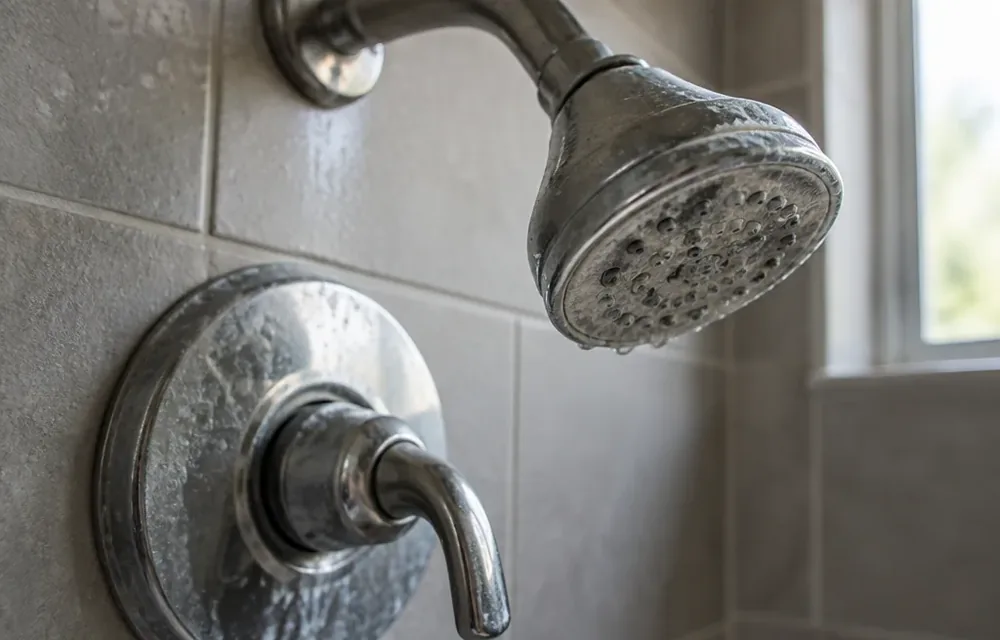
Fixture effects: Aerators, cartridges and shower faces narrow under scale until single-fixture flow thins, while soap binds into scum that mimics pressure trouble across rooms. Cleaning aerators first separates fixture restriction from system pressure loss in minutes. Persistent thinning after cleaning points to cartridges that need service rather than more scrubbing, following low water pressure causes checks.
Testing before hardware: Tested mineral levels with heater age, valve condition and fixture load attached keep sizing tied to the home rather than habit. Filtration ahead of softening shields media where sediment or iron joins hardness. That test-first sequence matches water treatment and filtration methods and the symptom guide linked above.
When should you call about water quality in your town
Call signals: Call about quality-driven plumbing when spotting pairs with heater rumble, when aerators clog within weeks, when orange staining or metallic taste joins hardness signs, or when treatment equipment alarms. Town-supply complaints with clean supplier reports point toward premise plumbing and heaters rather than chemistry. Well streets call on lab sheets rather than symptoms alone.
What to say on the call: Call (978) 592-1168 with your town, supplier and district where known, lab sheets with dates, heater age with noise notes, and photos of buildup ready. Mention well versus town source and which fixtures spot or clog fastest. That account lets the visit sequence testing, heater checks and treatment options correctly across Chelmsford, Westford and Reading.
Records that help most: Keep supplier reports, lab sheets, treatment manuals and heater records in one folder with your town row printed on top. Homes that bring all four get faster diagnoses and narrower proposals. Update the folder yearly as July reports publish.
Near you
When to call
Related guides

Frequently asked questions
Is Chelmsford water hard?
It depends on the district. Chelmsford Water District publishes no hardness figure while removing iron and manganese at its plants, and North Chelmsford Water District gives no number but says its well water is predisposed to being hard. North Chelmsford also averaged 94.4 ppm sodium in 2025. Test before buying a softener, and match your street to its district first.
Do I need a softener on MWRA water?
No. MWRA water tested 14.4 milligrams per liter in May 2026, about one grain per gallon, which is soft on any scale. Scale symptoms there trace to heaters, valves and habits instead. Direct the budget toward flushing, cartridges and pressure care.
Which towns near Chelmsford have the hardest water?
Among published figures, individual Sudbury wells reach 194 ppm, Concord ranges up to 117 with an 85 average, Westford sampled 83.5 in May 2025, and South Acton sits near 81. Billerica lands in the moderate 40 to 75 band. Private wells anywhere in the area can exceed all of these, so test yours.
Why is there so much sodium in my tap water?
Road salt reaching wells and rivers, natural deposits, and pH-adjusting treatment chemicals all add sodium. North Chelmsford, Woburn wells and Wilmington run well above the 20 ppm guideline for restricted diets. A salt-based softener adds more, so check with your doctor if you are on a low-sodium diet.
Where do the town numbers come from?
From 2025 supplier reports, MWRA May 2026 sampling and supplier water-quality pages, all read September 2026, with a link on every row. County-average estimates from third-party sites were excluded. No value here comes from our own sampling.
Still stuck?
Describe what you see when you call and a local specialist will guide the next step.