How cold winter 2025-2026 actually got
Season in numbers: Blue Hill Observatory records a winter mean of 26.5 degrees, 3.2 degrees below its 1991-2020 normal and the coldest in more than a decade, with maximums averaging 2.8 below normal and minimums 2.0 below. The season low reached minus 2 on February 8 after a December 19 high of 58 ahead of an Arctic front, and only a nine-day January thaw broke otherwise continuous Arctic outbreaks. Snowfall totaled 78.6 inches, 29.2 above normal and eleventh-highest on record, including the third-largest January storm and fifth-largest February storm ever measured there.
Local grid counts: ERA5 reanalysis for the Bedford-Hanscom grid cell counts 50 days with minimums below 20 degrees across December through February, against a 1991-2020 average of 33.9, and the Lowell cell counts 52 against 35.3. That is about 16 extra pipe-threatening nights and the fourth-highest count of the 36 winters in the 1991-2026 record in both cells, behind only 2003, 2011 and 1994. Subzero days told a different story: 4 in each cell against a normal of about 3, so this winter was defined by duration rather than extreme lows.
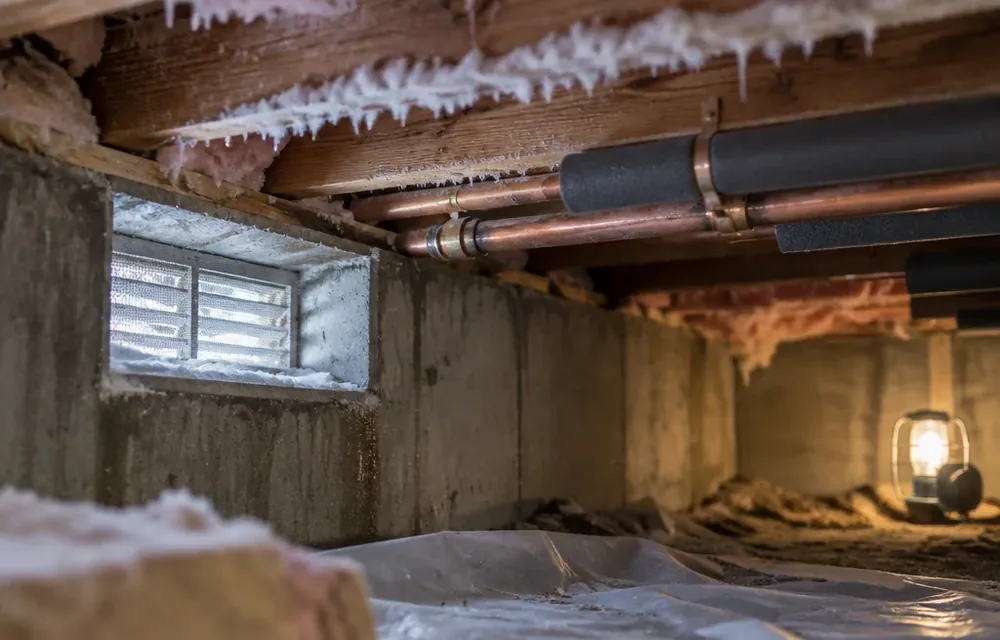
What cold plus snow means for pipes: Deep snow insulates ground-level runs while exposing rim-bay and attic piping to sustained cold, and the season dryness at 4.57 inches below normal precipitation kept soils hard around foundations. Two twenty-inch-plus snowstorms in one season, only the third such occurrence on record, loaded roofs and buried hose bibbs and vents for weeks. That combination punishes exactly the crawl-space, garage-wall, and addition piping our frozen-pipe pages warn about.
Reading guide: Each row below carries its named source and pull date; observatory rows describe measured seasonal records while reanalysis rows are modeled planning counts.
| Measure, winter 2025-2026 | Value | Source |
|---|---|---|
| Winter mean temperature | 26.5 F, coldest in 10+ years | Blue Hill Observatory, Mar 2026 |
| Seasonal low | Minus 2 F on Feb 8 | Blue Hill Observatory, Mar 2026 |
| Snowfall total | 78.6 in, 11th-highest on record | Blue Hill Observatory, Mar 2026 |
| Days below 20 F, Bedford-Hanscom | 50 days vs 33.9 normal; 4th of 36 winters, 1991-2026 | ERA5 reanalysis count, Sep 2026 |
| Days below 20 F, Lowell | 52 days vs 35.3 normal; 4th of 36 winters, 1991-2026 | ERA5 reanalysis count, Sep 2026 |
| Subzero days, both cells | 4 vs about 3 normal | ERA5 reanalysis count, Sep 2026 |
| Precipitation | 9.32 in, 4.57 in below normal | Blue Hill Observatory, Mar 2026 |
| Water/freezing share of 2024 HO claims | 48.6 percent statewide | MA Division of Insurance, Jan 2026 |
What the insurance record says
Statewide claims share: Massachusetts Division of Insurance data published January 2026 shows 48.6 percent of 2024 homeowners claims were for non-flood water and freezing losses, making water the dominant claim category statewide. The same notice stresses that coverage depends on proper heating and occupancy, since policies generally pay for sudden damage rather than gradual leaks. Put simply, nearly one in every two homeowners claims that year involved water or freezing.
Coverage conditions that matter: Most policies cover sudden and accidental burst damage only where the home stayed heated and occupied, which turns thermostat discipline and shutoff knowledge into coverage protection. Ice dam damage generally needs sudden onset rather than maintenance neglect. Confirming coverage types and amounts with an agent before winter beats discovering exclusions beside a flooded basement.
Reading the statistic honestly: The 48.6 percent figure describes 2024 claim counts statewide rather than predicting any winter or any town, and the colder 2025-2026 season plausibly pushed the next report higher without proving it yet. Treat the number as the reason prevention outranks reaction, not as a forecast for your street. Documentation habits below serve both the plumber visit and any future claim file.
Where Chelmsford area pipes froze first
Where pipes are most exposed: In this housing stock the runs that freeze first are predictable: crawl-space capes, garage-wall laundry lines, knee-wall baths, and slab-edge additions where plumbing sits against cold air. Finished basements tend to hide early freezes until thaw-day leaks show up, and low-lying streets can pair frozen supplies with sump and seepage trouble in the same week. Crawl-space capes common around Tewksbury and additions common around Westford fit that exposure profile.
Why duration beats extremes: Roughly fifty sub-20-degree nights punish marginal insulation that survives single cold snaps, since each cycle drives frost deeper into chases and rim bays. A pipe that survives one December cold snap can still fail in February after weeks of cumulative exposure. That duration effect is why seasonal hardening outperforms storm-week heroics: subzero nights ran close to normal, while the count of sub-20 nights ran about 16 above it.
What to tell dispatch: Mention which run froze with its exposure type, whether heat reaches that chase, where the nearest fixture and main shutoffs sit, and whether thaw has started with dripping or staining. Those facts decide whether the visit stages thawing, hardening, or emergency control through frozen pipe prevention and thawing methods.
Harden in order before the first frost
Ordered checklist: Ordered hardening starts outside and moves in: shut off and drain exterior hose bibbs from inside valves, seal rim-bay and chase air leaks, insulate exposed runs without hiding valves, verify heat reaches every plumbing chase, and confirm main and fixture shutoffs turn freely. Ordered hardening finishes with hose and heat-tape circuits tested where installed and the household briefed on trickle and cabinet-door tactics for the coldest nights.
Priorities by housing: Crawl-space capes need vent sealing with chase heat first, garage-wall laundries need insulation plus shutoff access, additions need rim-bay air sealing where original and new framing meet, and finished basements need access panels over key valves before emergency closures. Well streets add pit and pressure-tank freeze protection that town-water streets never consider. Match the checklist to your housing type rather than working top to bottom blindly.
Weekend-safe versus visit work: Homeowners can drain bibbs, open cabinets, hold trickles, and photograph shutoff locations without touching piping. Insulation upgrades, heat-tape circuits, chase heating, and valve replacements belong with licensed handling under state rules. That boundary matches homeowner plumbing rules and keeps preparation safe on both sides.
Methodology and sources
Observatory record: Seasonal statistics come from the Blue Hill Observatory winter 2025-2026 summary published March 2026, covering December through February means, extremes, snowfall rankings, and normals departures. That record is the longest continuous weather series in North America and the authoritative seasonal context for eastern Massachusetts. Attribution appears in the manner the observatory requests for published use of its summaries.
Grid counts and claims: Day counts derive from ERA5 reanalysis daily minimums for the Bedford-Hanscom and Lowell grid cells, December 2025 through February 2026, counted in-house as days below 20 and below zero, with the same count run for every winter from 1990-1991 onward to set the 1991-2020 averages and the 36-winter ranking. Reanalysis models estimate rather than measure, so counts carry model uncertainty and serve planning rather than records. The claims share comes from the Division of Insurance cold-snap notice of January 2026 reporting 2024 statewide data.
What this report omits: Street-level freeze logs and per-town damage totals sit outside verified sources for this edition, and the cold-day normals here come from reanalysis rather than station thermometers. Future editions can add official station normals and claim-year updates as agencies publish them. Coverage stays inside what the three sources above support, with no extrapolated town rankings.
Thaw-day and emergency rules
Thaw behavior: Frozen pipes often reveal themselves at thaw with dripping at joints, staining spreading across ceilings, and meters creeping with fixtures off. Warm the space gradually, open the nearest faucet to relieve pressure, and watch every exposed joint while flow returns. Never torch pipes or pour boiling water on concentrated spots, since thermal shock splits what ice only stressed.
When it becomes an emergency: Active spreading water, sewage involvement, no heat with pipes at risk, and gas odor near equipment each escalate past scheduled thawing into emergency response. Shut the nearest fixture valve then the main where flow continues, kill power to wet electrical areas from dry ground, and call (978) 592-1168 with the exposure type and shutoff state ready. Review what counts as an emergency while help is arranged.
After-action records: Photograph damage with dates, keep invoices naming materials and locations, note shutoff positions and response times, and file the insurance notice promptly with the full sequence attached. Those records serve both the repair plan and any claim review. Homes that document each freeze build the case for hardening grants, targeted repipes, and coverage without argument.
When should you book hardening work
Calendar logic: Book hardening surveys in September and October so insulation, heat tape, and valve work complete before the first sustained freeze, since November cold snaps arrive most years with little warning. Emergency thawing capacity tightens with each Arctic outbreak, which makes preseason scheduling worth more than storm-week availability. This report publishes mid-September on exactly that logic.
What to ask for: Ask for a chase-by-chase exposure survey with photos, a shutoff operability check at every fixture and the main, insulation and heat-trace scope with access notes, and a written cold-night playbook for the household. Confirm permit needs where piping changes rather than just wraps. That scope fits frozen pipe prevention and thawing visits with winterize plumbing reading behind it.
Who this season threatens most: Crawl-space capes with prior freezes, additions over unheated space, garage-wall laundries, finished basements with hidden valves, and well streets with pit exposure top the watch list after a winter like 2025-2026 proved the pattern again. If last season found your weak run, this October is the appointment. Call (978) 592-1168 with the housing type and freeze history ready.
Near you
When to call
Related guides
Frequently asked questions
How cold did winter 2025-2026 get around Chelmsford?
Blue Hill recorded a winter mean of 26.5 degrees, coldest in more than a decade, with a seasonal low of minus 2 on February 8. Grid estimates count 50 sub-20-degree days at Bedford-Hanscom and 52 at Lowell, about 16 above the 1991-2020 average and the fourth-highest of the 1991-2026 winters, with 4 subzero days each. Snowfall reached 78.6 inches, eleventh-highest on record.
Does homeowner insurance cover burst pipes?
Most policies cover sudden and accidental burst damage where the home stayed heated and occupied, per the state Division of Insurance notice. Nearly half of 2024 statewide homeowners claims involved non-flood water or freezing. Confirm coverage types with an agent before winter rather than after damage.
What should I harden before the first frost?
Drain exterior bibbs from inside valves, seal rim-bay and chase air leaks, insulate exposed runs, verify heat reaches every plumbing chase, and confirm all shutoffs turn freely. Prioritize by housing type, with crawl-space capes and additions first. Book surveys in September and October.
Is it too late to prepare once freezes start?
Chase heating, insulation, and valve work proceed all season, though scheduling tightens with each outbreak. Storm-week preparation still beats none: bibb draining, cabinet opening, and trickle tactics work on short notice. Permanent hardening simply waits for the next calm window.
Where does this report data come from?
Seasonal statistics from the Blue Hill Observatory winter summary, day counts from ERA5 reanalysis grid cells computed for this article, and claims share from the Division of Insurance January 2026 notice. Methodology names each source with its limits, and no town-level damage ranking is attempted.
Still stuck?
Describe what you see when you call and a local specialist will guide the next step.