Signs
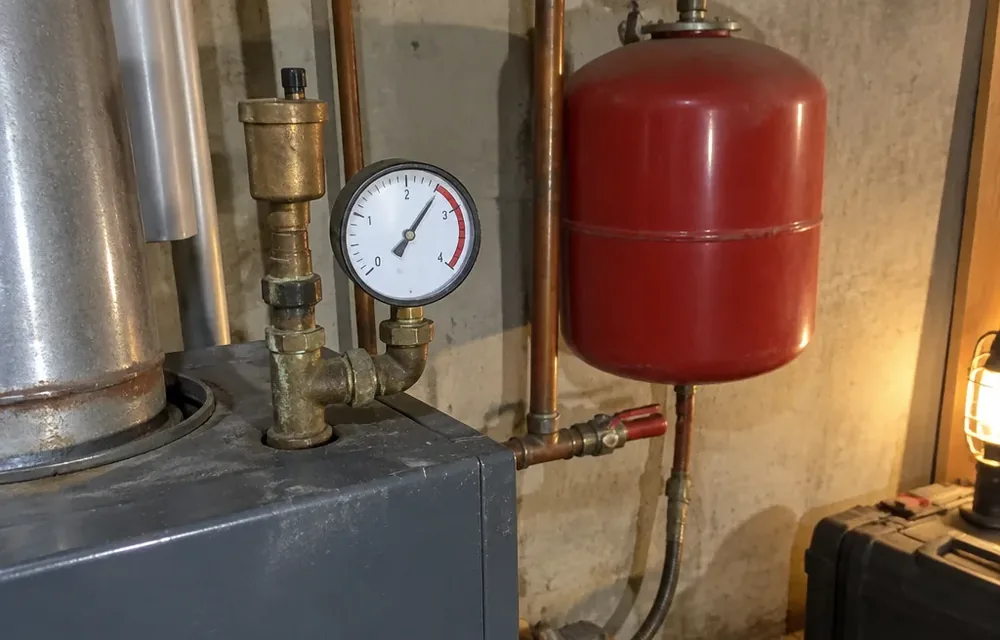
Gauge climbing past the normal band
Cold readings above the marked range, or hot readings pushing toward relief, show the system carries more water pressure than designed.
Relief valve dripping or discharging
Water at the relief drain pipe proves pressure or temperature exceeded the safety limit and the valve did its job.
Frequent radiator bleeding needed
Air that keeps returning to high radiators often enters with repeated manual refills chasing falling pressure elsewhere.
Boiler short cycling with heat swings
Excess pressure with air pockets stalls circulation, so zones heat unevenly while the burner starts and stops.
What high boiler pressure means
Direct answer: High boiler pressure means the closed heating loop holds more water volume or less air cushion than designed, so normal heating expansion pushes the gauge into warning range. Cold systems rest near their marked fill pressure, and heating expansion lifts the needle a predictable amount that the expansion tank absorbs. Readings beyond that travel mark a fault in filling, cushioning, or control rather than normal operation.
Fill-side causes: A manual fill valve left cracked open keeps feeding town water into the loop around the clock, and automatic feeders with failed regulators do the same silently. Repeated homeowner top-ups after bleeding add water without removing the underlying air or leak, ratcheting pressure higher with each visit to the valve. Closing the manual feed and watching the gauge over a day separates active overfilling from one-time excess, which is the first test before any part discussion. See boiler no-heat patterns for the low-pressure mirror image.
Cushion-side causes: Expansion tanks with ruptured bladders or lost air charge leave water with nowhere to expand, so even correct fill volume spikes the gauge with each firing. Undersized tanks on added zones, waterlogged conventional tanks without their air charge maintained, and isolated tank valves that take the cushion offline produce the same climb. Tapping the tank for a dull full line and reading its air charge with the system drained to zero separates cushion failure from fill failure in minutes.
Safe homeowner checks and hard limits
Direct answer: Homeowners can safely read gauges, close manual fill valves, note relief discharge, and record which zones heat while waiting. Opening relief valves by hand, draining loops without a refill plan, or adjusting controls and regulators belongs with the visit rather than trial and error. Pressure plus heat plus water in one appliance rewards respect over improvisation.
Checks to try: Read the gauge cold and again at full heat and write both numbers down with the time, since that pair tells the visit how far expansion travels. Close the manual fill valve fully and watch whether the cold reading holds or keeps climbing, which proves or clears active overfilling. Note relief drips, recent bleeding or top-ups, and any new radiators or zones added since last service. Photograph the gauge and the feed valve position so nothing relies on memory under stress.
Limits to honor: Never cap, plug, or valve off a relief discharge line, since the relief path is the last protection the system has. Do not keep bleeding radiators daily to manage pressure, because each bleed invites fresh oxygenated water that corrodes from inside. If relief discharge runs steadily, if the gauge pins at its limit, or if steam, odor, or flooding joins the picture, stop and call (978) 592-1168 rather than managing it another day.
Look-alikes worth ruling out
Direct answer: Faulty gauges, air-bound zones, and domestic coil leaks each mimic high pressure while needing different corrections. A gauge with a stuck needle reads high on a normal system, air trapped high in the loop reads as pressure trouble with cold radiators, and a pinhole in the tankless coil feeds town pressure into the loop invisibly. Verifying the gauge against a test instrument comes before believing any single reading.
Air versus water excess: Cold upstairs radiators with a high gauge usually mean air occupies the top while water overfills below, often after repeated top-ups chased the air around the loop. Proper venting with correct fill procedure restores both readings together, while more water alone worsens the split. That is why bleeding without checking feed and charge often trades one symptom for another within days.
Coil leak signature: Pressure that climbs only when the domestic hot water runs, with the heating loop otherwise steady, points to the tankless coil leaking town pressure across into heating water. Rising pressure with no fill activity and no heat calls fits the same fault. Coil isolation testing with the domestic side watched separately proves it, and that finding moves the plan to coil or heater work through water heater service rather than loop controls.
Where pressure trouble shows locally
Direct answer: Pressure trouble shows most in tall colonials with long radiator loops, in split-levels with added zones on original tanks, and in homes where owners top up frequently through heating season. Multi-zone valves and circulators added without expansion review shrink the cushion per zone, and high town supply pressure behind a failed feeder fills loops faster than old low-pressure setups ever did. Finished basements around the boiler hide early relief drips until stains appear.
Housing and water mix: Strong street pressure from town supply pushes more water through every cracked feeder seat, so Chelmsford area loops overfill faster than well-supplied loops at lower pressure. Colonials near Concord with tall radiator columns, splits near Acton with added baseboard zones, and triple-deckers near Lowell with stacked heating loads each stress cushioning differently. Homes with recent remodels that added zones without tank review deserve charge and sizing checks before another heating season.
What to tell dispatch: Mention cold and hot gauge readings with times, relief drip behavior, recent bleeding and top-up history, and any added zones or remodels since last service. Note whether pressure climbs with heat calls, with hot water use, or around the clock, since each timing names a different fault. Those facts let the visit bring gauge test gear, tank charge tools, and feeder parts through boiler help in one trip.
What a visit for high pressure involves
Direct answer: A visit proves gauge truth, fill behavior, cushion charge, and coil integrity in that order before any part is chosen. We test the gauge against a known instrument, isolate the feed to watch for creep, read expansion charge at zero system pressure, and check the relief path and discharge condition. Only the failed element gets corrected, and the loop gets vented and refilled by procedure rather than by feel.
Corrections that hold: Feeder rebuilding or replacement where regulation failed, manual valves closed and proven, expansion tanks recharged or replaced to matched size, relief valves replaced where they weep below rating, and coil work where cross-leakage proves out. Each correction gets retested through full heat cycles with cold and hot readings recorded, and vents get bled in sequence so air leaves without inviting excess water back in.
Retest and records: The visit closes with documented cold and hot pressures, charge readings, feed behavior, and relief proof, plus guidance on what normal seasonal movement looks like so future readings get judged fairly. Where leaks were found feeding the overfill habit, detection follows leak detection and burst pipe repair methods. Where relief discharge ran long enough to wet finishes, timing respects emergency plumbing caution until drying is confirmed.
The service that fixes it
Related services
Related problems
Frequently asked questions
What pressure should my boiler gauge show?
Most residential loops rest near their marked cold fill range and rise a modest, predictable amount at full heat, with exact bands set by the system design and relief rating. Readings past the marked range cold, or climbing toward relief hot, mark a fault rather than normal expansion. Record cold and hot numbers with times for the visit.
Why does the relief valve keep dripping?
The relief valve drips because pressure or temperature exceeded its safety setting, through overfilling, lost expansion cushion, control faults, or coil leakage feeding town pressure across. The drip proves the valve works, so never cap its drain line. Gauge, feed, and charge testing finds which cause drives it.
Can I just bleed radiators to lower pressure?
Bleeding lowers the gauge briefly but invites fresh water that corrodes the system from inside, and repeated bleeding with automatic feeding ratchets mineral load higher each cycle. Proper correction fixes the fill or cushion fault, then vents and refills by procedure once. Daily bleeding is a warning pattern, not maintenance.
Does high pressure mean I need a new boiler?
Rarely, since feeders, tanks, gauges, relief valves, and coils cause most high-pressure readings while the boiler block itself stays sound. Component testing in fill, cushion, and coil order finds the failed element. Replacement enters only where the block or exchanger itself proves faulty.
Seeing boiler pressure too high?
Call and describe the symptom. A local specialist will tell you the sensible next step.